
Dealer Takes All
Mexican author Juan Rulfo's The Golden Cockerel

“Whatever gift Fortune bestows upon a man, let him think while he enjoys it, that it will prove as fickle as the goddess from whom it came.” —Seneca1
“… the work of human beings turns to nothing …” Homer2
“Les jeux sont faits, messieurs et mesdames!”
The Roman patrician and philosopher Boethius came to a messy end: thuggish executioners bludgeoned the life out of him with clubs. There was a macabre irony to this, because he’d been one of the most senior officials in the Ostrogothic court of Theodoric the Great, ruler of the Western Roman Empire. But through no fault (probably) of his own, he fell from the paranoiac king’s grace in AD 523, was imprisoned for months, and then brutally killed.
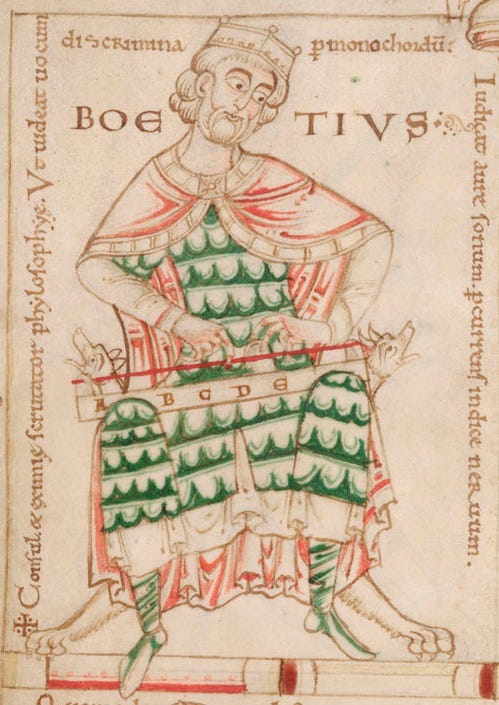
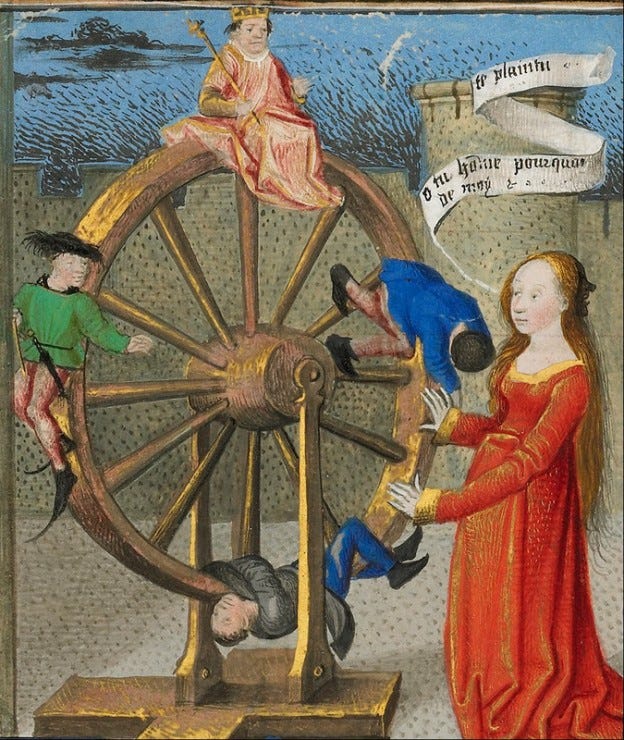
During the months he languished in prison, Boethius fought against despair by reflecting on the ups and downs of his own life as well as the fragility of human happiness in a manuscript that became a classic: The Consolation of Philosophy. In it, he warned against trusting too much in the goddess Fortuna. Properly surnamed Automatia, “she who does what she will,”3 inconstancy, Boethius wrote, “is her normal behavior, her true nature.” Sometimes she blesses and sometimes curses, spinning the wheel of chance and not caring in the least where it stops.
“With domineering hand she moves the turning wheel,
Like currents in a treacherous bay swept to and fro [...]
Such is the game she plays.
Of mighty power she makes parade when one short hour
Sees happiness from utter desolation grow.”4
Juan Rulfo’s novella The Golden Cockerel, written in the mid-1950s but not published until 1980, is a parable about the perversity of fortune. Its characters are all gamblers, constantly testing the limits of their luck with both cockfighting and cards. But Fortuna, ringmaster and dealer, inevitably wins, even if she teasingly allows the players to think otherwise for a time. She, not they, controls the game of life.
It’s not surprising that Rulfo nearly called his novel De la nada a la nada: From Nothing to Nothing. Boethius argued that humans can cultivate a philosophical indifference to the whims of fortune, thereby immunizing themselves to some extent against unhappiness. No so for the characters in The Golden Cockerel. Tied as they are to Fortuna’s wheel, their endings, like their beginnings, are empty. For Rulfo, this isn’t tragedy so much as simply the way things are, for them and for humanity, too.
“This filthy bruja!”
Dionisio Pinzón is the novella’s protagonist. In all his works, Rulfo carefully christens his characters with names that carry deep significance. In Dionisio’s case, his first name reminds us of Dionysus, the divine exemplar of manic passion; his second is the Spanish word for “finch,” a bird associated in Christian folklore with the Passion of Christ. Rulfo seems to be hinting that Dionisio is the bearer of uncontrollable passion—in his case, greed—and the suffering that comes from relying on Fortuna. From the get-go, then, Dionisio carries a spiritual weakness, symbolized by a physical deformity. One of his arms, we’re told, is “disfigured, who knows just how.”5
Because his withered arm makes him unfit for labor, Dionisio, who lives with his invalid mother, gets by as best he can serving as his town’s crier, a rather Kafkaesque job that obliges him to go “from street corner to street corner shouting the description of some lost animal, of a missing boy, or of a lost girl.”6 It places him at the very bottom of the social pecking order.
But one day his luck changes. He’s given a golden fighting cock so badly mauled in a match that its disgusted owner wants nothing more to do with it. Dionisio takes the bird home, buries it up to its neck in the earthen floor of his shack, and nurses it back to health. After a few days, “the breath of resurrection flowed in and out of [the cock’s] partially open beak.”7 The symbolism is obvious: the rooster is associated with both Christ’s Passion (the biblical thrice-crowing that shatters Peter) and Easter morning (chanticleer gustily announcing a new day). Its emergence from an earthen tomb inaugurates a fresh start for Dionisio.
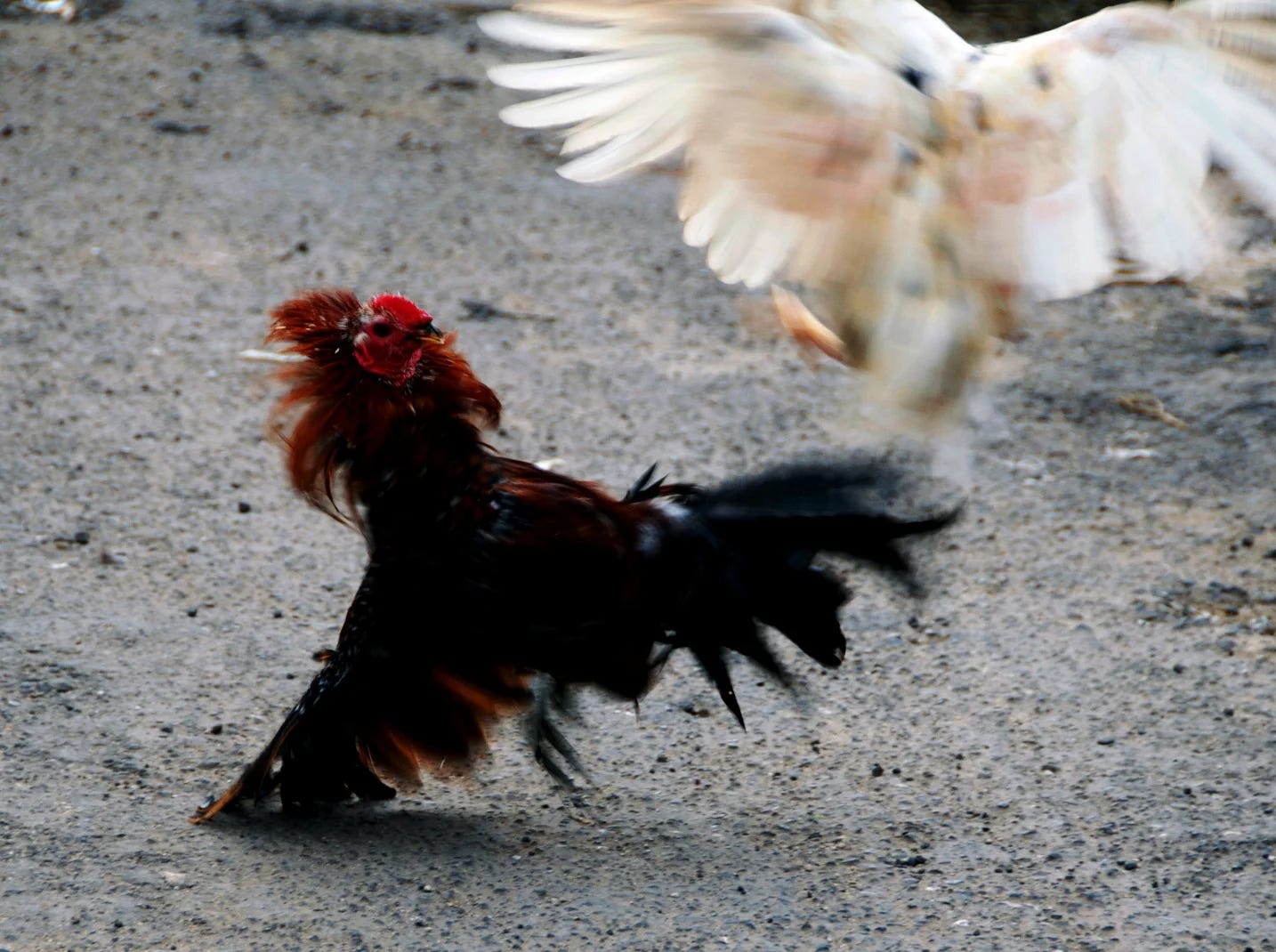
Soon after the bird’s resurrection, Dionisio’s mother dies. With nothing to keep him in his dreary little village, he takes to the road with the golden cockerel—which, aside from its Christian significance, is a traditional symbol of good fortune—“determined to roll the dice with that animalito.”8 Fortuna smiles on him. The cock seems undefeatable, earning Dionisio lucrative victories in fight after fight. But the wheel turns and so does his luck. His fighting cock is bested by a stronger—luckier?—bird and Dionisio, who wagered his entire bankroll on this final match, is once again broke.
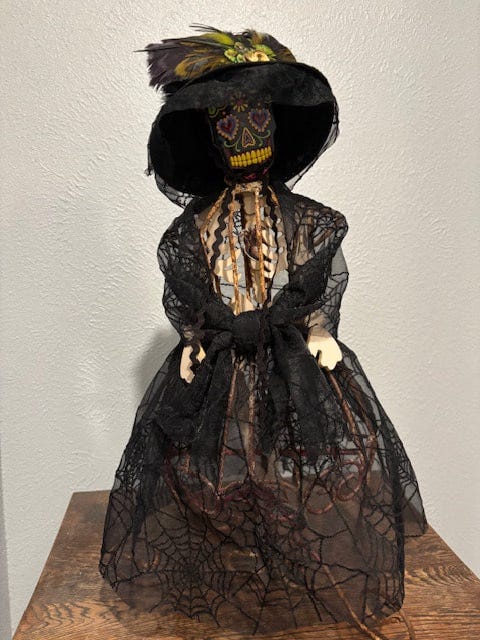
It’s at this point that he meets one of the novella’s most significant and mysterious characters: the exotic singer Bernarda Cutiño, whom everyone calls La Caponera. I understand that the Spanish word has multiple meanings. But given that Bernarda is described in the tale as having “sway over men,”9 the most appropriate rendering here is probably “Lead Mare.”10 On the surface, her influence is sexual. Gamblers are intoxicated by her exotic Siren-like beauty. As the story proceeds, it becomes increasingly clear that La Caponera is the personification of Fortuna. Because her “calling is to wander the earth,”11 she callously tosses to one side any of her numerous lovers who try to control or bind her. “No one can do that to me,” she insists. “I just can’t.”12
Under La Caponera’s tutelage, Dionisio’s fortunes quickly revive. In addition to his successful return to cockfighting he takes up card gambling. Occasionally La Caponera tires of his company and takes to the road, leaving him on his own. During these interludes, his luck predictably runs out. But she always returns, and whenever she does, his luck is assured. Surprisingly, given her resistance to being tied down, she agrees to marry Dionisio. This triumph only increases his confidence that he’s on top of the world. But when he boasts of his success to one of La Caponera’s past lovers—someone she deserted long ago, thereby robbing him of his luck—the furious man screams a hard-won truth at Dionisio: “You owe everything to this filthy bruja!”13 It’s the turn of the wheel, not your own efforts, that’s brought you success!
“Why didn’t you let me know?”
But like most of us, Dionisio doesn’t want to believe that his prosperity is simply a matter of luck. He clings to the conviction that he’s the master of his fate—that he “makes his own luck,” as the saying goes. So he brushes aside the past lover’s warning. “Little by little,” we’re told, his success “had turned him to stone, transforming him into a cold and calculating man, sure and confident in the path of his destiny.”14
At the same time that he fancies himself a self-made man, though, he continues to believe that La Caponera is his good luck charm, attesting to the perverse skill we humans possess for simultaneously holding contradictory notions. So when Dionisio turns the mansion he and Bernarda share into a casino, he “determined that she should always be there with the gamblers in the great hall, close to him or at least where he could sense her presence.”15 As long as she sits quietly in the room behind him as he plays cards, he can’t lose.
But the wheel of fortune never stops spinning, and it begins its final turn against Dionisio, symbolized by the gradual fading away of La Caponera.
“She gave the appearance of being a permanent shadow settled in a high-backed armchair; after all, it was difficult to make out her face or to gauge her movements, seeing as she always wore black and hid from the light that illuminated little more than the circle of card players. She, on the other hand, could well observe all of the others from her obscurity.”16
The end comes when the over-confident Dionisio bets again and again in a high roller game, staking everything he owns—money, stable of fighting cocks, property, land—only to lose it all. But how?! La Caponera, his good luck charm, sat behind him as he played, just as she always did! How could he have lost? When he turns to confront here, he discovers that she died at the beginning of the game. Instead of mourning her passing, he’s furious, just like all her earlier lovers were when she deserted them. “He kept shaking his wife and shouting at her: —Why didn’t you let me know you had died, Bernarda?” Then, abruptly, he goes into an adjoining room and shoots himself.17 What’s the point of living when Fortuna forsakes you?
There’s a coda to the story. Dionisio and La Caponera had a daughter, also named Bernarda. After the burial of her parents, she announces that she plans “to follow my mother’s destiny. That’s how I can honor her wishes.”18 She’ll take to the road as an alluringly exotic singer at cockfights and gambling dens. She’ll entice, tease, seduce, build expectations, and then desert. Fortuna never really perishes. She and her wheel resurrect in each new generation.
There Is No Payout
We frequently feel that our lives aren’t really all that much under our control. Fate or chance, gluey determinism or dizzying gratuitousness, seems to herd us. Even if we might have some say in the choices we make, their outcomes are often uncertain. Les jeux sont faits, mesdame et messieurs. Les jeux sont faits. We make our bets and wait to see where the wheel stops.
It does no good to place ourselves in the hands of Fortuna and hope for the best, because her nature is to be inconstant. As Boethius wrote centuries ago, “Do you really value the presence of Fortuna when you cannot trust her to stay and when her departure will plunge you in sorrow?” Wouldn’t it be wiser, he asks, to resist her blandishments altogether instead of “committing your boat to the winds and sailing whichever way they blow, not just where you want?”19
Fortuna’s inherent inconstancy ought to be a warning that any hope of controlling her is delusional. Once the chips are down, the game is hers to control. “If after freely choosing her as the mistress to rule your life you want to draw up a law to control her coming and going, you will be acting without any justification and your very impatience will only worsen a lot which you cannot alter.”20 This is why La Caponera refuses to be tied down by any of her wooers, and why she eventually departs—dies—when Dionisio tries to corral her.
Boethius leaves open the possibility that Fortuna’s desertion may, in the long run, be a good thing. Good luck tends to enslave us, as it did Dionisio, by giving us the false confidence that breeds arrogance. It’s deceitful. But bad luck is harshly truthful, exposing and warning us about Fortuna’s fickleness. “By her flattery good fortune lures men away from the path of true good, but adverse fortune frequently draws men back to their true good like a shepherdess with her crook.”21 It’s bitter to lose at the cockfight or card table. But it can provide us with a lesson about what’s really important that otherwise mightn’t sink in. The last thing Fortuna wants to see in us is self-reflection.
But this is Boethius speaking, not Rulfo. In his bleak world, Fortuna is indeed a bruja who takes a cruel pleasure in bewitching us, teasing us, and whispering promises in our ears that she has no intention of honoring. For Boethius, Fortuna is neutral. But Rulfo’s La Caponera is malignant. She entices—and in Dionisio’s case, even weds—only to destroy. She uses our greed as her weapon.
And we’re relatively easy prey, all too eager to follow her, no matter how many times she lets us down, because we foolishly imagine that success lies just around the corner. All we need is that one golden break, that one payout, that one winning streak, that one lucky roll of the dice. In our greed and stupidity, we continue to court Fortuna until, tiring of stringing us along, she dumps us. Then our dreams, as Homer said, turn to nothing. Dealer takes all.
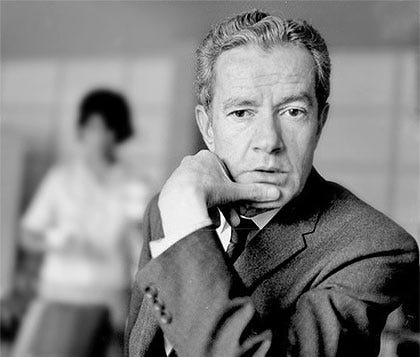
This is the first of a three-part series on Juan Rulfo’s fiction. Next up is his collection of short stories entitled The Burning Plain.
Seneca, “On Consolation: To Marcia,” in Minor Dialogues. Trans. Aubrey Stewart (London: George Bell and Sons, 1889), p. 174.
Homer, Iliad. Trans. Emily Wilson (New York: W.W. Norton, 2023), p. 393. [Book 16, line 501]
Boethius, The Consolation of Philosophy. Trans. V.E. Watts (New York: Penguin, 1969), p. 55.
Ibid., p. 56.
Juan Rulfo, The Golden Cockerel & Other Stories. Trans. J. Weatherford (Dallas, TX: Deep Vellum, 2017), p. 40.
Ibid., p. 39.
Ibid., p. 47.
Ibid., p. 49.
Ibid., p. 43.
This was suggested by Alfred Mac Adam in his translation of a selection from The Golden Cockerel (which he rendered The Golden Cock) in Review: Latin American Literature and Arts 26/46 (1992/93): 37-41. See also Douglas J. Weatherford’s “Introduction” to The Golden Cockerel & Other Writings, ibid., pp. 31-32.
Rulfo, Golden Cockerel, op. cit., p. 54.
Ibid., p. 80.
Ibid., p. 87.
Ibid., p. 75.
Ibid., p. 94.
Ibid., p. 95.
Ibid., p. 106.
Ibid., p. 107.
Boethius, Consolation, op.cit., p. 55.
Ibid.
Ibid., p. 76.