
Leaping Over the Wall
A Blue Rider Lent: Part 4 of 5

“The spirit breaks down fortresses.” —Franz Marc1
“I become a transparent eyeball.” Ralph Waldo Emerson2
Poet John Donne famously noted that “no man is an island.” Yet we sometimes feel otherwise, don’t we? There are uncomfortably claustrophobic moments when it seems as if we’re locked in cages of egoistic desires and cultural conditioning, powerless to touch base with the actual world. We feel trapped in a kaleidoscope of artificialities that hide rather than reveal the true nature of things.

All of the Blue Riders felt this sense of being imprisoned, as Franz Marc said, within fortress walls, and sought release through artistic beauty. They believed that if they could only clear their interior palates of “impurity,” they could “jump over the dark wall” to commune with Spirit. “We seek beyond the veil of appearance the hidden things in nature.”3 But this quest, Marc believed, requires the spiritual disciplines of “contemplation, proper restraint, conscience.”4
Previous posts in the series:
Prologue: “To Cause Vibrations in the Soul”
Part 1: Beauty Opens Our Eyes to Mystery
Part 2: Pilgrims of the In-Between
Part 3: Listening to the World
I don’t know if Marc was familiar with Ralph Waldo Emerson. But he would’ve resonated with the Concord Sage’s proclamation that to be a “lover of uncontained and immortal beauty”—to be totally open to what Emerson called the “Over-Soul”—one must escape the egoic and cultural fortress. One must become a “transparent eyeball.”
“Standing on the bare ground,—my head bathed by the blithe air, and uplifted into infinite space,—all mean egotism vanishes. I become a transparent eyeball; I am nothing; I see all; the currents of the Universal Being circulate through me; I am part or particle of God.”5
This is what Marc strove to be.


From Potential Pulpit to Actual Easel
Some artists know from an early age that they want to paint. Marc, whose work is probably better known today than any other Blue Rider’s, wasn’t one of them. He didn’t turn to painting until he was twenty, and it took another decade for him to develop his own style. But in just four years—his career and life were cut short in the Battle of Verdun6—he produced a number of expressionistic animal portraits, including the blue horse ones, that hauntingly conveyed his longing for communion with the natural world and, through it, with Spirit.


Born in 1880 in Munich, Franz was one of those youths whose curiosity and imagination lead them to pursue a number of interests that, although seemingly disparate, eventually converge. Raised in a devout Protestant home that encouraged wide reading, he determined while still in his teens to study for the ministry. Soon deciding that he was unworthy of a calling, he switched for a time from theology to literature and philosophy, only discovering when he was twenty that his true vocation was art. As he said at the time, “Truthfully speaking I’ve been an artist all my life, but education and environment and my own disposition have meant that I’ve also been half-minister and half-philologian. […] Now, though, I know for certain that I have found what is right for my nature.”7
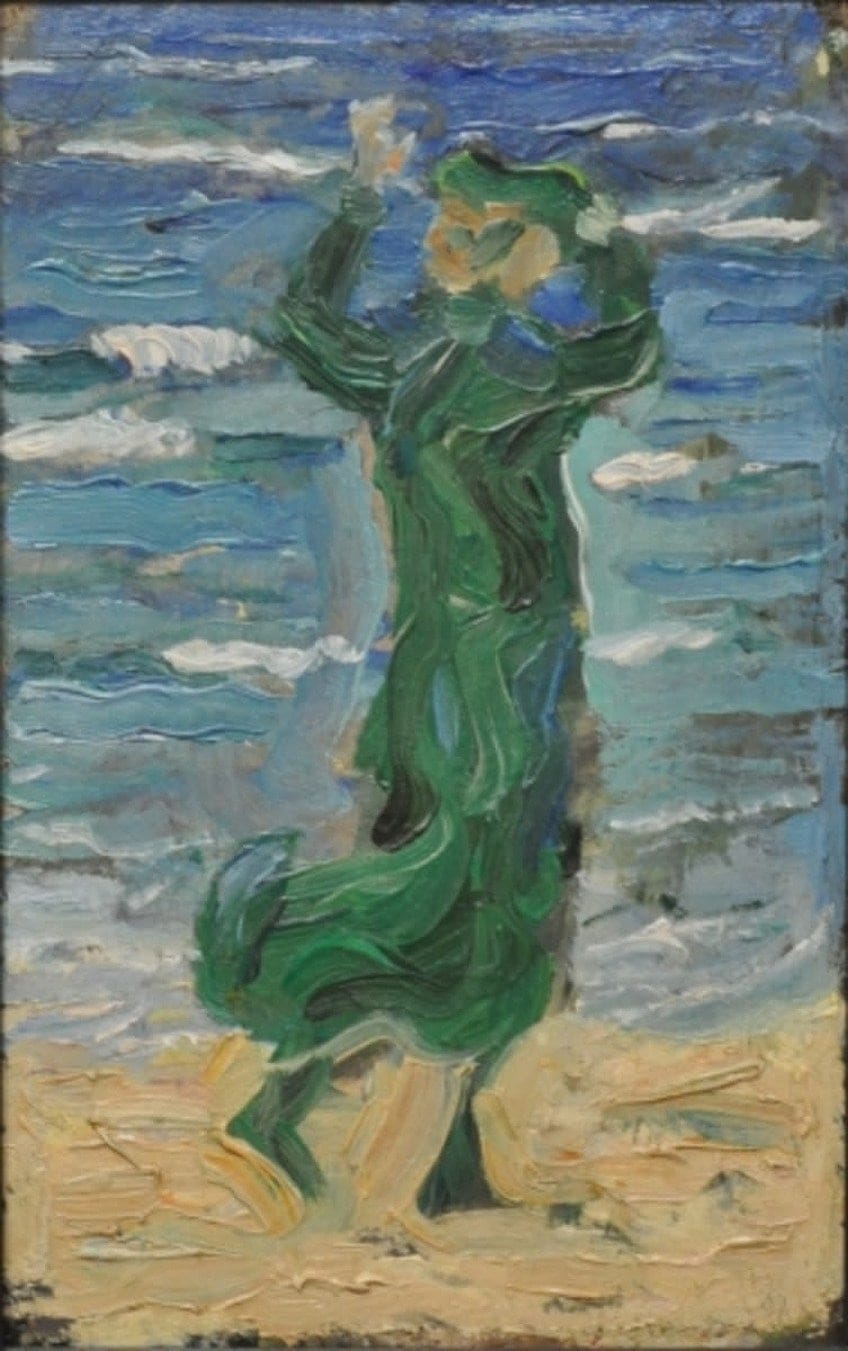
Three years of study at the Munich Art Academy convinced Marc that the naturalist-realist style in which he was being trained was aesthetically and spiritually stymieing. Exposure to Impressionist and post-Impressionist paintings during a 1903 visit to France was a breakthrough for him, and for the next few years his work reflected the influence of Corbet, van Gogh, and Gauguin.
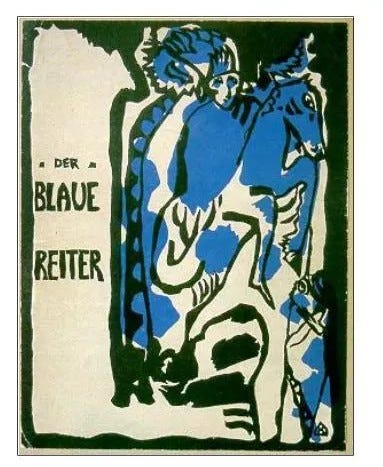
By 1911, when he became associated with the artists of the Blue Rider group, Marc had come into his own. He collaborated with Wassily Kandinsky in editing the Blue Rider Almanac, contributing no fewer than three essays to it, and remained an active member until the 1914 outbreak of war. During his months of military service, unable to paint, he turned his attention to writing essays and aphorisms that explored the interconnections between art, philosophy, and theology.
Objects and Predicates, Shells and Kernels
Marc feared that we dwell in an increasingly disenchanted world, reducing reality and everything in it—including ourselves—to the status of easily classifiable objects. We create vast taxonomic structures that attempt to fast-freeze creation’s dynamism. They’re convenient and they have a certain practical value. But they also distort.
Theological speculation as well as everyday religiosity can also devolve into taxonomic exercises that objectify Spirit. Theologians imprison the Divine in fortresses of abstraction and dogma, worshippers in folk tradition and arcane ritual. God ceases to be a Thou, a Verb, a Presence and becomes an It, a Noun, a Thing.
Marc’s artistic sensibility rebelled against this modern tendency towards objectification. He insisted that “naturalism” as both a worldview and an artistic style was the culprit, arguing via a grammatical metaphor that it focuses on the “object” or noun at the expense of the “predicate” or quality. But it’s the latter to which we should attend. “The predicate, the most difficult and basically the most important part, is rendered but rarely,” wrote Marc. “I could paint a picture called ‘The Doe.’ I may also want to paint a picture: ‘The Doe Feels.’ How infinitely more subtle must the artist’s sensitivity be in order to paint that!”8
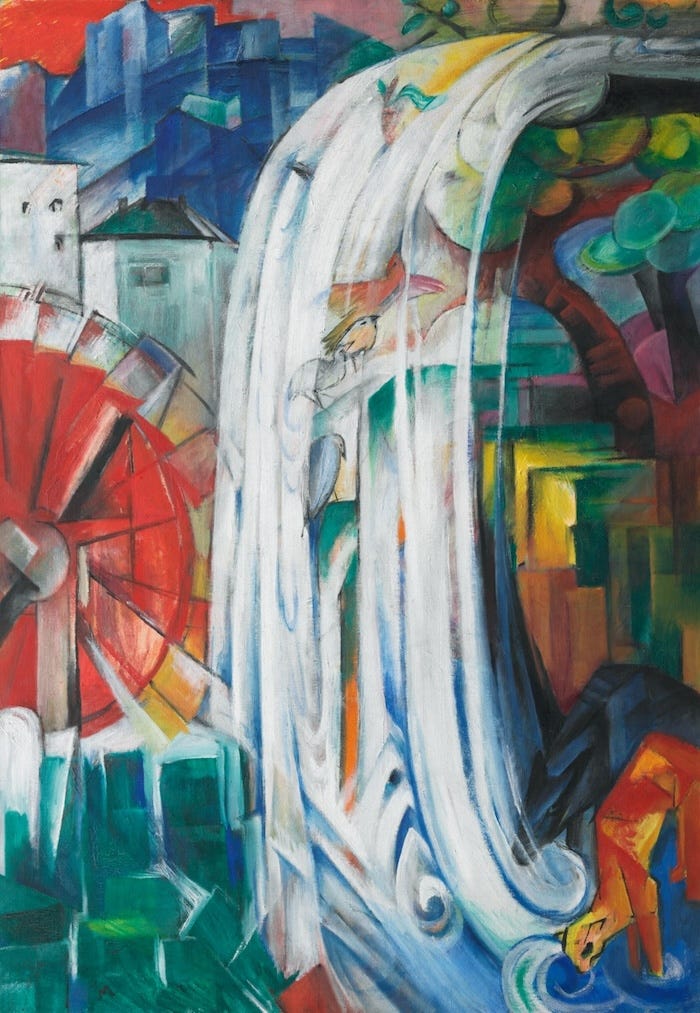
To express through the medium of art that which defies easy categorization: the inner essence, the indwelling Spirit, of things: that was what Marc aimed for in his work. As one of his aphorisms suggests, he wanted to discover the kernel in the shell.
“Everything has appearance and essence, shell and kernel, mask and truth. What does it say against the inner determination of things that we finger the shell without reaching the kernel, that we live with appearance without perceiving the essence, that the mask of things so blinds us, that we cannot find the truth?”9
“Genuine” art that pushes past the shell is truly revelatory: “its inner life guarantees its truth.” It offers images that evoke sensitivity to beauty and the ineffable—“predicates”— instead of merely affirming and legitimizing the hard-edged objectified way culture trains people to see the world. “Perhaps,” hopes Marc in words that echo his youthful pastoral aspirations, “the viewer will begin to dream in front of the new painting and encourage his soul to move onto a new plane.”10
A Virginal Sense of Life
Marc was a great lover of animals, and many of his most notable works in the four years of his association with the Blue Riders are portraits of cows, foxes, deer, monkeys and, of course, horses. But there’s nothing sentimental about them. Marc sensed in animals, unburdened as they are both by human rationality and wickedness, pure expressions of spirit; being transparent eyeballs comes naturally to them. The “instinct that led me away from people,” he wrote, directed him “to a feeling for animality, for the ‘pure beasts.’ People with their lack of piety, especially men, never touched my true feelings. But animals with their virginal sense of life awakened all that is good in me.”11


Touching base with that virginal sense of life meant going beyond conventional representations of animals that treated them, as he said in his grammatical metaphor, as nouns or “objects.” What Marc sought was to discern their inwardness—their qualitative or “predicate” natures. He wanted to see through their eyes, to view the world as they, not as humans, do.12
“Is there a more mysterious idea for an artist than to imagine how nature is reflected in the eye of an animal? How does a horse see the world, how does an eagle, a doe, or a dog? It is a poverty-stricken convention to place animals into landscapes as seen my men; instead, we should contemplate the soul of the animal to divine its way of sight.”13
He was trying, he noted, to “enhance” his “sensibility for the organic rhythm” that “pantheistically” pulsates through creation. In trying to enter into the inner lives of animals, he hoped to express in his art “the flow of ‘blood’ in nature, in the trees, in the animals, in the air.”14 By “flow of blood,” Marc of course means vitality, the animating: Spirit.


That spiritual vitality comes through, for example, in two of Marc’s bovine portraits. In “The White Bull,” we see a horned bull curled up in sleep within a leafy enclosure, his entire body expressing calm restfulness. Gazing at the picture, we experience something of his serenity. “The Yellow Cow,” by contrast, is exuberantly joyful. The cow leaps through a landscape bursting with vibrant colors, an ecstatic expression on her face, as if she’s no longer earthbound: a perfect metaphor for leaping over the dark wall. Marc’s genius in this, one of his best-known paintings, allows us to feel the cow’s interiority, her “predicate.”


Or take another pair, Marc’s “Fox” and “Tiger.” The former lies sleeping. But unlike “The White Bull,” this portrait, given the vivid colors on which the fox lies as well as its alertly raised ears, suggests sharp attentiveness—not anxiety or fear—even when the creature is in repose. It’s not too much to suspect that Jesus’s injunction to “stay awake” or Paul’s “pray unceasingly” might’ve been in the back of Marc’s biblically literate mind in painting the fox.
The wakeful “Tiger” exudes a sense of raw power, accentuated by the muscularly block-like way in which Marc paints his body. To a human observer, culturally habituated to viewing tigers as dangerously predatory creatures, his eyes and face may look menacing. But because Marc wants to “contemplate” and express the tiger’s “soul” or interiority—how the tiger sees the world rather than how we humans see the tiger—the face expresses keenly intent scrutiny of the world.
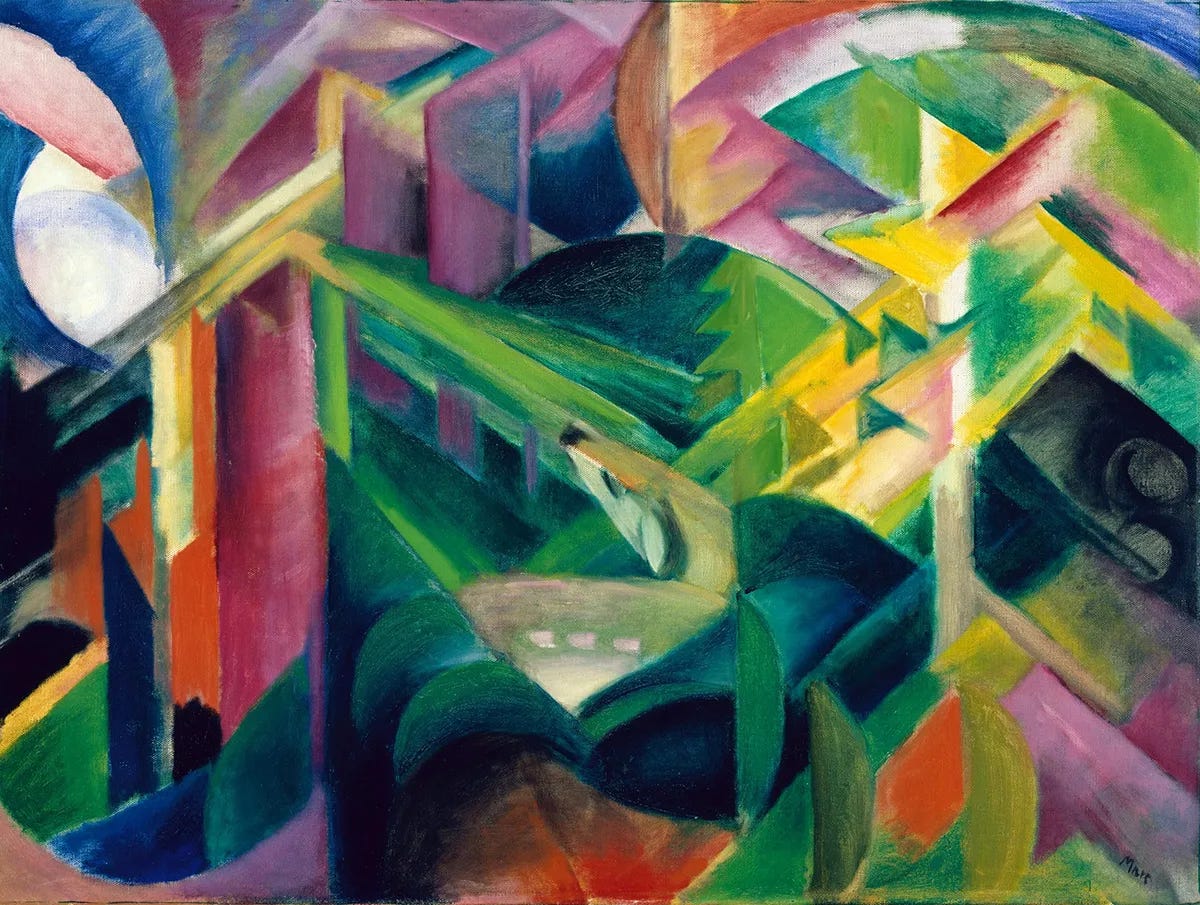
A different and magnificent expression of the “organic rhythm” that courses “pantheistically” through nature is Marc’s 1914 “Playing Forms.” We don’t know the direction his artwork would’ve taken had he survived World War I.15 But he was moving steadily toward a more abstract style as evidenced in this nearly six foot-long painting, completely shortly before he was called up for military service.
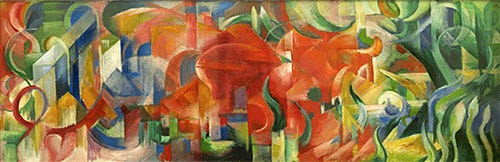
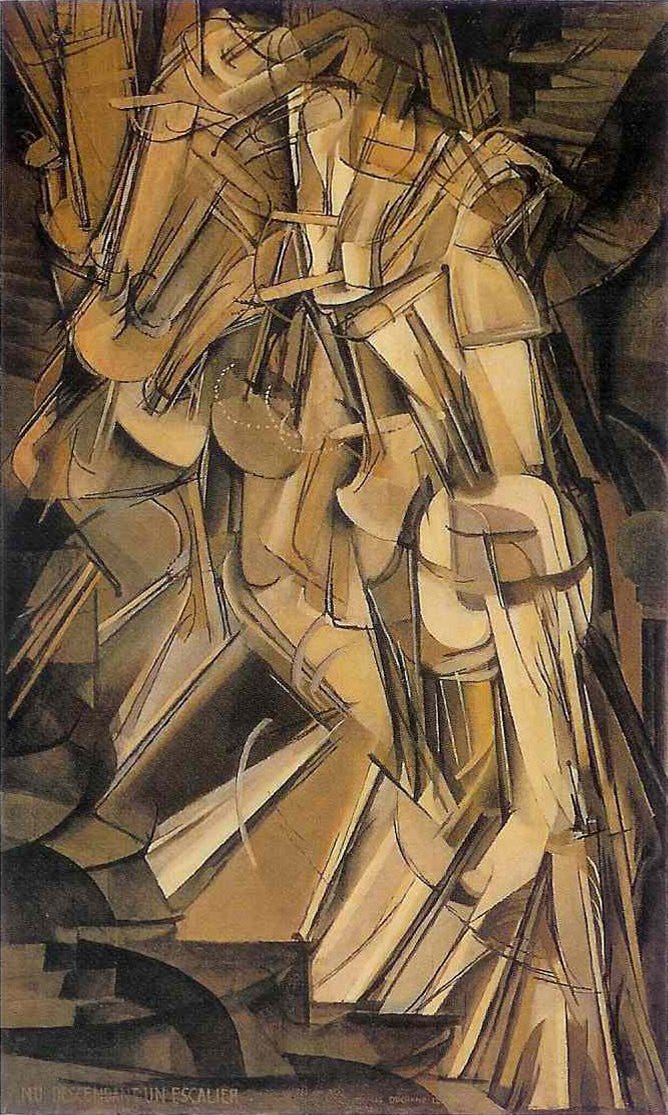
The presence of animals is suggested: a brown flank and leg, blue-white horns, snouts, gracefully curved green necks. But all is in motion, everything is fluid, creating a gorgeously kinetic impression (rivaling in its depiction of movement, by the way, Duchamp’s 1911 “Nude Descending a Staircase,”16 a painting that Marc almost certainly never saw).
“Playing Forms” may well be Marc’s most successful expression of what it means to view the world as animals do, to see through their eyes. When we humans look around us, we inevitably “see” defined and named objects: this “fox,” that “yellow cow,” that “white dog lying in the snow.” Our perceptions are typically filtered through our learned categories and classifications. But surely that’s not how animals see the world. They neither name nor define; instead, they experience in an unfiltered way, just as transparent eyeballs would. Marc’s painting seeks to capture something of what that perceptual innocence is like.
Inwardness of Perception
Did Marc himself manage to become a transparent eyeball, seeing the world nakedly and immaculately as do the animals he painted? Almost certainly not. The inner essence of things, whether we’re talking about animals, inanimate objects, or other humans, is likely to forever allude us. And that goes double when it comes to our experiences of God or Spirit. We long for communion, for an unfiltered relationship with the Divine. But the best we can do is experience occasional flashes, a fleeting moment or two of nearly clear vision. The afterglow of these moments lingers for a bit but inevitably disappears, leaving us hungering for more yet also oddly satisfied. Wordsworth captures their feel in “Tintern Abbey,”
And I have felt
A presence that disturbs me with the joy
Of elevated thoughts; a sense sublime
Of something far more deeply interfused,
Whose dwelling is the light of setting suns,
And the round ocean and the living air,
And the blue sky, and in the mind of man:
A motion and a spirit, that impels
All thinking things, all objects of all thought,
And rolls through all things.
If these moments don’t come to us, it may be because we think of God as an object rather than a predicate: an It, not a Thou, a frozen Perfection instead of a continuously vibrant Loving. Similarly, we may see the created order as nothing more than a collection of physical laws and ready-to-hand raw materials. Spirit is banished, and the world, as Marc feared, grows cold with disenchantment.
Happily, there are spiritual catalysts that begin to remove the film from our eyes and improve our odds of experiencing moments of communion with God and God’s creation. The wilderness experience of Lent traditionally encourages us to take advantage of three of them: prayer, charity, and fasting. As we’ve seen, Marc offered his own trinity of spiritual disciplines: contemplation, proper restraint, and conscience. But for him and all the Blue Riders, artistic beauty was the chosen springboard for leaping over the wall and making contact with what Wordsworth calls presence and Emerson the Over-Soul. Art, insisted Marc, can “encourage [our] soul[s] to move onto a new plane.”
That’s why he wanted his paintings to express a “complete spiritualization and dematerialized inwardness of perception”17 that draws us away from the conceptual and cultural walls in whose dank shadows we too often crouch. Meditating on Marc’s artwork can coax us to a place of illumination where, as Emerson said, “all mean egotism vanishes.” Then we are as close to being transparent eyeballs as we can get and, being nothing but seeing all, become “part or particle of God.”
Franz Marc, “Spiritual Treasures.” In The Blue Rider. Trans. Henning Falkenstein (New York: Viking, 1974), p. 60.
Ralph Waldo Emerson, “Nature.” In Selected Writings, ed. William H. Gilman (New York: New American Library, 1965), p. 189.
Franz Marc, “Die Neue Malerei,” Pan II (1912), p. 556. Quoted in Frederick S. Levine, The Apocalyptic Vision: The Art of Franz Marc as German Expressionism (New York: Harper & Row, 1979), p. 85.
Franz Marc, Letter (12 April 1915). Quoted in ibid., p. 181.
Emerson, “Nature,” op. cit., p. 189.
Besides Marc, three other promising German Expressionist artists perished in that horrible conflict. Two, Hermann Stenner (1891-1914) and Marc’s close friend August Macke (1887-1914), were killed in action almost immediately. Marc perished in 1916, and Wilhelm Morgner (1891-1917) a year later. It was a colossally tragic waste.
Franz Marc, Letter (21 June 1900). Quoted in Susanna Partsch, Franz Marc, 1880-1916. Trans. Karen Williams (London: Taschen, 2001), p. 8.
Franz Marc, “How Does a Horse See the World?” In Herschel B. Chipp (ed), Theories of Modern Art: A Source Book by Artists and Critics (Berkeley, CA: University of California Press, 1968), p. 179.
Franz Marc, “Aphorisms.” In ibid., p. 180.
Franz Marc, “Two Pictures. In The Blue Rider, op. cit., p. 68.
Franz Marc, Letter (12 April 1915). In Chipp, Theories of Modern Art, op. cit., p. 182.
A couple of months after learning of Marc’s battlefield death, his friend Paul Klee (using the present tense, as if Marc were still alive), mused about the animal paintings. “He responds to animals as if they were human. He raises them to his level. He does not begin by dissolving himself, becoming merely a part of the whole, so as to place himself on the same level with plants and stones and animals.” Although Klee meant this as praise, I think he’s completely misunderstood his friend’s goal. Marc’s writing demonstrates that he very much wanted to “place himself on the same level with plants and stones and animals,” to “see” the world as they do. Paul Klee, Diaries 1898-1918. Ed/trans. Felix Klee (Berkeley, CA: University of California Press, 1964), pp. 343-344.
Franz Marc, “How Does a Horse See the World?” In Chipp, Theories of Modern Art, op. cit., p. 178.
Franz Marc, Letter (8 December 1908). Quoted in Levine, The Apocalyptic Vision, op. cit., p. 44.
As Europe stumbled towards the First World War amid growing tensions, Marc’s mood darkened. In a late 1913 painting, “Fate of the Animals,” he depicts a chaotic, almost apocalyptic explosion in which animals are furiously blasted and twisted by uncontrolled forces. The next year, his abstract “Fighting Forms” symbolizes a world gone mad with violence. Marc never had much faith in human goodness. But his war experiences so shook him that, towards the end, he even doubted the innocence of animals. As he wrote in a letter from the front line, “I discovered in animals, too, so much that was ugly and unfeeling—and instinctively, by an inner compulsion, my presentation became more schematic and more abstract. … Trees, flowers, the earth all showed me every year more and more of their deformity and repulsiveness — until now, suddenly, I have become fully conscious of nature’s ugliness and impurity.” Franz Marc, Letter (12 April 1915). In Chipp, Theories of Modern Art, op. cit., p. 182. Would this somber way of looking at the world have persisted had Marc survived the war?


Marcel Duchamp, “Nude Descending a Staircase, No. 1” (1912).
Franz Marc, quoted in Levine, The Apocalyptic Vision, op. cit., p. 56. This is a line from Marc’s furious denunciation of the critics of the September 1910 Neue Künstlervereinigung München (NKVM) exhibition. The response to the avant-garde paintings was brutal. As Kandinsky later described it, “The press loosed a total rage against the exhibition, the public laughed, threatened, spat upon the pictures. For us, as exhibitors, the public reaction was incomprehensible.” Marc’s defense of the exhibition inaugurated his relationship with the artists who would later comprise the Blue Rider group.